
Turn Business Documents Into Knowledge Your Teams Can Use
Connect approved documents and knowledge sources to help teams find relevant information, investigate complex questions, compare records and prepare traceable outputs without manually searching every file.
Powered by Document Intelligence and the governed retrieval, orchestration and control capabilities of Ainfinite Core.
Important Knowledge Becomes Difficult to Use When It Is Buried Across Files
Policies, reports, contracts, operational documents and business records often sit across different repositories, formats and versions. Teams spend time locating information before they can begin the actual work.
Search Finds Files, Not Always the Required Evidence
Traditional keyword search may return multiple documents without identifying the exact section, table or statement needed for the task.
Different Versions Create Uncertainty
Teams may find several copies of the same document without knowing which version is current, approved or relevant to their business context.
Research Requires Repeated Manual Compilation
Complex questions often require information from several documents. People must search, read, compare and assemble the findings manually.
Document Differences Are Easy to Miss
Terms, values, clauses, dates and obligations may differ across documents. Identifying those differences requires detailed human review.
Outputs Need to Be Traceable
An answer or report is more useful when reviewers can see the documents and passages supporting it.
The real knowledge gap sits between the documents an organisation already has and the evidence employees need to complete their work.
Move From Document Search to Evidence-Backed Work
AI can organise documents, retrieve relevant passages, compare information and prepare an output. Permissions, source boundaries and human review determine what information can be used and what happens next.
Seven-Step Document Intelligence Flow
Define the Task → Verify Access → Retrieve Sources → Process the Evidence → Compare and Reason → Cite and Flag → Review or Route
- 01
Define the Task
A user asks a business question or starts a document workflow such as classification, research, reconciliation or report preparation.
- 02
Verify Access
Confirm the user’s identity, role and permissions before searching or processing enterprise information.
- 03
Retrieve Approved Sources
Search only the repositories, document groups and information categories permitted for the user and task.
- 04
Process the Evidence
Extract relevant text and document structure. Apply OCR to supported scans where required and technically configured.
- 05
Compare and Reason
Bring relevant passages together, identify relationships and differences, and apply the defined workflow instructions.
- 06
Cite and Flag
Prepare a source-linked answer, research output, reconciliation result or draft. Flag missing, conflicting or insufficient evidence.
- 07
Review or Route
The responsible employee reviews the result, approves the output or routes the document to the next business process.
Before and After
Employees search folders, open multiple files, compare versions manually and reconstruct the supporting evidence for every output.
The system retrieves permitted information, presents the relevant evidence, identifies differences and prepares a traceable result for human review.
Apply Document Intelligence Where Evidence Must Become Actionable
Start with workflows where teams repeatedly search, classify, compare or compile information from approved business documents.
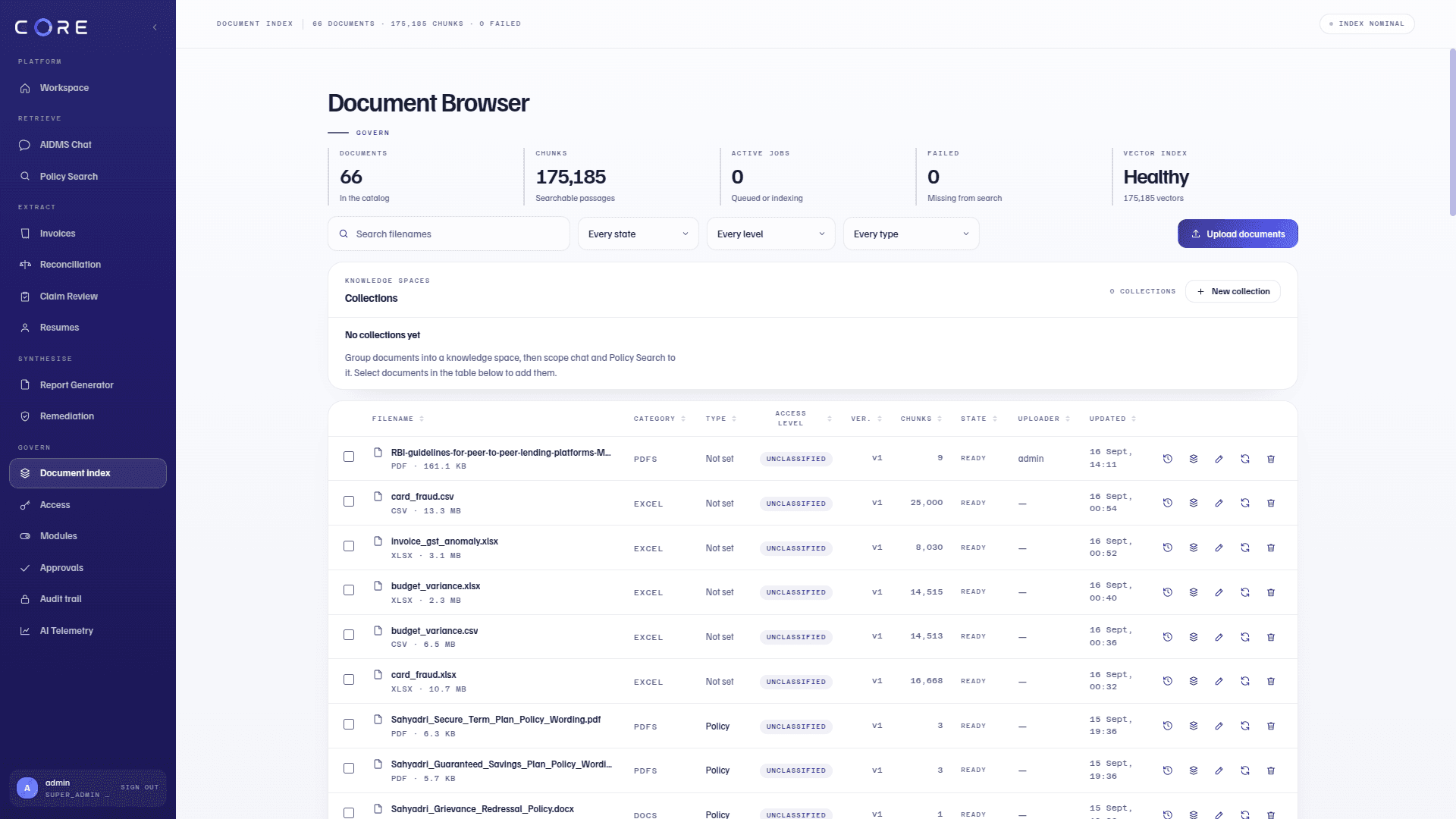
Intelligent Document Triage
Identify the document type, apply approved classification labels and route the document to the relevant workflow or team.
Evidence-Backed Business Answers
Respond to business questions using retrieved information from approved enterprise sources, with supporting document references.
Enterprise Knowledge Discovery
Search business documents by meaning, keywords, metadata and context rather than relying only on filenames or exact terms.
Multi-Source Investigation
Research a complex subject across multiple approved documents and organise the findings into a structured evidence set.
Structured Output Preparation
Turn retrieved information and approved evidence into the first draft of a report or business document for human review.
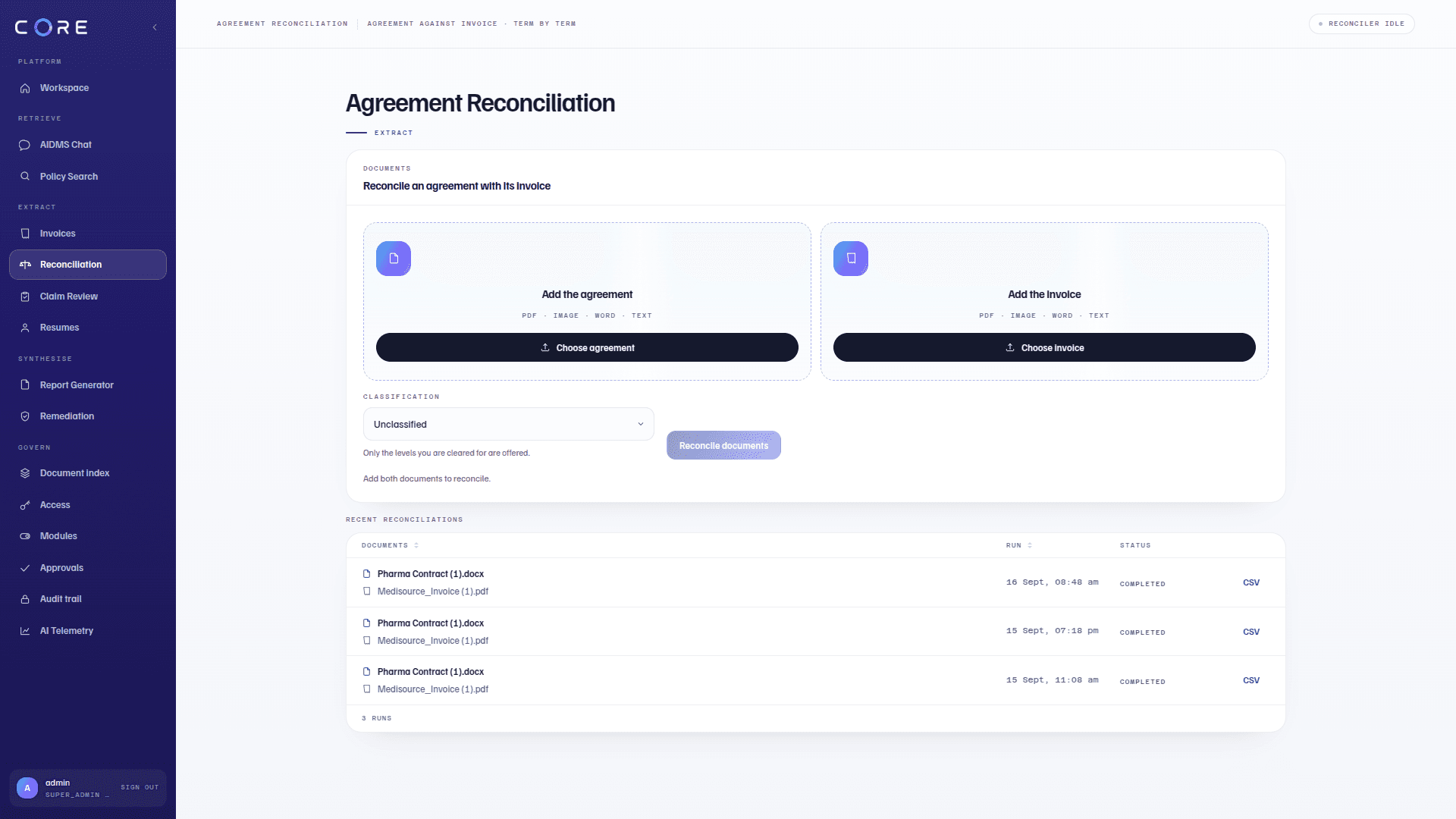
Cross-Document Validation
Compare documents, identify differences and surface exceptions requiring human attention.
Document Intelligence
AI-Powered Enterprise Document and Knowledge Platform
Document Intelligence provides the document-processing, retrieval, comparison and output capabilities used within this solution.
Explore Document IntelligenceRole of Ainfinite Core
Ainfinite Core can provide the underlying:
Prepare the documents
- Document-processing pipeline
Connect the evidence
- Enterprise retrieval
- Model gateway
Control the context
- Permissions and context controls
- Workflow orchestration
Review the output
- Human approval points
- Output evaluation
- Audit information
Control What the AI Can Retrieve, Reference and Produce
The solution uses a controlled document-processing and retrieval pipeline so enterprise knowledge can be searched and used according to source, permission and workflow requirements.
Enterprise Source Layer
Depending on the implementation, approved sources may include:
- PDF and Office documents
- Scanned documents
- Policies and procedures
- Reports and research files
- Contracts and commercial documents
- Spreadsheets
- Document repositories
- Business-system records
- Approved databases and APIs
Document-Processing Layer
- File validation
- OCR where supported
- Text and layout extraction
- Table and section detection where supported
- Document classification
- Metadata capture
- Cleaning and normalisation
- Chunking and enrichment
Knowledge and Indexing Layer
- Search index
- Vector representations
- Document metadata
- Source ownership
- Version information
- Effective dates
- Security labels
- Retention information where configured
Retrieval and Intelligence Layer
- Keyword retrieval
- Semantic retrieval
- Hybrid search
- Metadata filtering
- Permission filtering
- Relevance ranking
- Evidence assembly
- Selected AI model
- Source-linked output preparation
Workflow and Control Layer
- User authentication
- Role-based access
- Source restrictions
- Workflow rules
- Human approvals
- Output validation
- Exception routing
- Audit records
- Evaluation and monitoring
Integration Categories
Document and Productivity Systems
Approved document repositories, shared drives and productivity platforms.
Business Applications
ERP, CRM, HRMS and other operational systems where the required information and access methods are confirmed.
Collaboration and Communication
Email, collaboration applications and workflow tools used to deliver or review outputs.
Data and Custom Applications
Approved databases, APIs and custom business software.
Knowledge Guardrails
Permission-Aware Retrieval
Users should only retrieve information they are already authorised to access.
Source Traceability
Answers and generated outputs should show the supporting source documents or passages where the workflow requires evidence.
Insufficient-Evidence Handling
If the approved sources do not support an answer, the system should state that sufficient information was not found instead of inventing a conclusion.
Version and Date Controls
Retrieval should prioritise the approved and applicable document version using available metadata and business rules.
Sensitive-Information Controls
Apply redaction, field filtering or minimum-necessary context where the information requires additional protection.
Retrieved-Document Security
Treat document content as enterprise data, not as trusted system instructions. Suspicious or unauthorised content should not be allowed to override application controls.
Human Approval
Reports, reconciliations, legal interpretations, compliance conclusions and high-impact workflow actions should be reviewed by an authorised person.
Evaluation
Test retrieval relevance, citation validity, classification quality, reconciliation accuracy and failure handling using representative business documents.
Grounding is not simply connecting documents to a language model. It requires controlled ingestion, secure retrieval, evidence traceability and evaluated outputs.
Measure Whether Information Becomes Easier to Find, Verify and Use
Measure the selected document workflow against its current baseline. Focus on retrieval quality, traceability, processing exceptions and human acceptance rather than generic AI productivity claims.
Search and Answer Measures
- Search success rate
- Relevant-source retrieval rate
- Citation coverage
- Citation validity
- Unsupported-answer rate
- Insufficient-evidence detection
- Average time to locate supporting information
- Human acceptance or correction rate
Classification and Routing Measures
- Documents processed
- Classification accuracy
- Routing accuracy
- Unclassified-document rate
- Manual correction rate
- Processing exception rate
- Average routing time
Research and Reporting Measures
- Research workflows completed
- Source coverage
- Report drafts prepared
- Human review time
- Draft revision rate
- Missing-evidence flags
- Output approval rate
Reconciliation Measures
- Document comparisons completed
- Differences identified
- Exceptions confirmed by reviewers
- False-positive exception rate
- Time to complete reconciliation
- Unresolved differences
Intended Business Outcomes
Find and verify
- Faster access to approved business knowledge
- More traceable answers and outputs
- Better visibility into source evidence
Prepare and compare
- More consistent document classification
- Clearer identification of document differences
- Reduced manual compilation across document-heavy work
Protect the information
- Better control over who can access sensitive information
Industry Variations


Banking and Financial Services
Search and compare policies, operating procedures, reports and approved financial documents with stricter access and audit controls.
Government and Public Sector
Organise circulars, policies, notices and departmental knowledge according to approved information boundaries.
Evidence and Case Study Rule
Do not publish document-processing accuracy, time-saving percentages, ROI figures or customer performance results until they have been measured and approved.
If no verified public case study is available, use a controlled pilot demonstration instead of an invented customer story.
Future Case Study Structure
- 01Document-intensive business problem
- 02Existing sources and repositories
- 03Previous manual workflow
- 04Configured retrieval or document process
- 05Permission and human-review controls
- 06Verified operational results
- 07Expansion into additional document workflows
Prove the Knowledge Workflow With Your Own Documents
Choose one document-intensive business problem, connect an approved source set and test the system using real questions, exceptions and review requirements before expanding the knowledge environment.
Seven-Step Implementation Path
Choose the Workflow → Audit the Sources → Define Access → Prepare the Knowledge Layer → Configure the Intelligence → Evaluate Real Tasks → Approve and Expand
- 01
Choose the Workflow
Select one high-value use case such as enterprise search, document classification, multi-source research or reconciliation.
- 02
Audit the Sources
Identify the document types, formats, ownership, versions, quality issues and available metadata.
- 03
Define Access
Map user roles, source permissions, sensitive information and required document boundaries.
- 04
Prepare the Knowledge Layer
Extract, clean, classify, chunk and index the approved document sample.
- 05
Configure the Intelligence
Set retrieval methods, metadata filters, model behaviour, citation requirements, workflow rules and human-review points.
- 06
Evaluate Real Tasks
Test the pilot with representative business questions, document variations, missing information and exception cases.
- 07
Approve and Expand
Expand to additional repositories, teams and document workflows only after the pilot meets the agreed quality, security and operational requirements.

Start with one document problem. Prove the evidence path. Expand into an enterprise knowledge system.
Bring one document-heavy workflow and an approved source sample. We’ll help define the retrieval architecture, controls and evaluation criteria required for a focused pilot.
Visit www.ainfinite.ai