
Build a More Predictable Path From Invoice to Cash
Bring receivables, customer communication, payment commitments and collection activity into one intelligence-led workflow so finance teams can understand what needs attention, why it matters and what should happen next.
Powered by OptimAR and the governed intelligence foundation of Ainfinite Core.
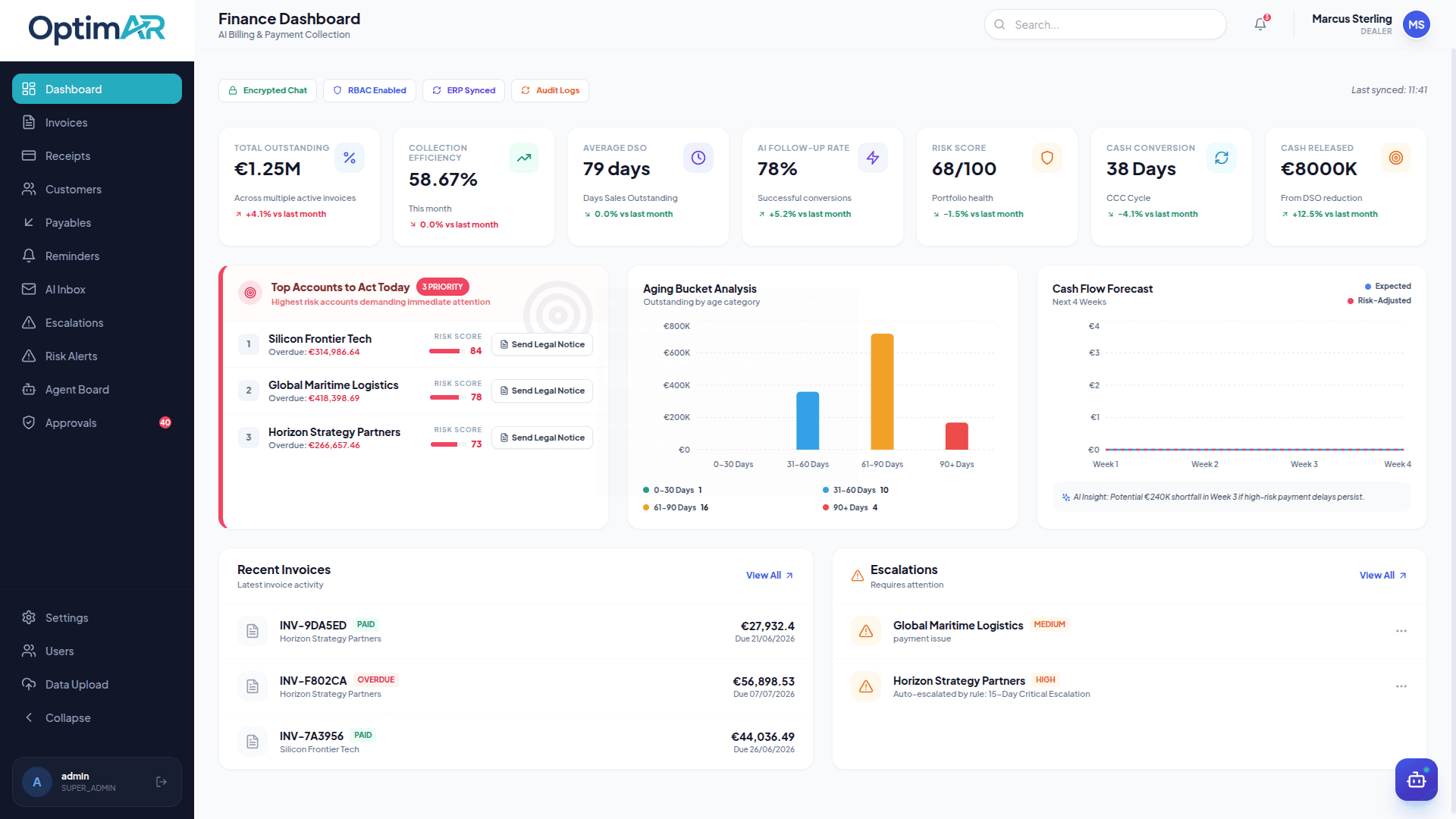
- Receivables Intelligence
- Collection Prioritisation
- Payment Commitment Tracking
- Workflow Visibility
Knowing What Is Overdue Is Not the Same as Knowing What to Do Next
Most finance systems can show balances, invoices and ageing. The harder problem is understanding the context around each overdue account: who was contacted, what the customer said, whether a payment was promised, whether an invoice is disputed and which account deserves attention first.

Who It Is For
- 01CFOs and Finance Directors
- 02Accounts Receivable Leaders
- 03Credit and Collections Managers
- 04Finance Operations Teams
- 05Shared-Service Centres
- 06Treasury and Working Capital Teams
- 07Business-unit Finance Leaders
- 08IT and Finance Transformation Teams
Outstanding balances
| Account | Balance | Status |
|---|---|---|
| Account A | Same value | Overdue |
| Account B | Same value | Overdue |
Account context
- Invoice status
- Overdue
- Customer response
- Supporting information requested
- Payment commitment
- Awaiting confirmation
- Dispute status
- Requires review
- Next action
- Finance professional reviews context
Outstanding Value Does Not Explain Collection Priority
Two customers may owe the same amount but require completely different actions based on ageing, previous commitments, disputes, account history and customer communication.
Customer Conversations Sit Outside the Financial Record
An ERP may show that an invoice remains unpaid without showing what the customer said, what information was requested or when payment was promised.
Collection Knowledge Becomes Person-Dependent
Important account context can remain inside individual inboxes, spreadsheets, call notes or the memory of a particular collector.
Follow-Ups Become Activity Without Direction
Teams may send more reminders without knowing whether an account needs a standard follow-up, supporting documentation, commercial intervention or escalation.
Payment Commitments Are Difficult to Track Consistently
Promise-to-pay dates can be buried in emails, messages or notes, making missed commitments difficult to identify systematically.
Management Visibility Arrives Too Late
Finance leaders often see consolidated ageing after the fact rather than a current operational picture of commitments, disputes, collection activity and emerging exceptions.
The receivables problem is not simply finding unpaid invoices. It is bringing financial and customer context together quickly enough to decide what should happen next.
Give Every Account a Clearer Next Step
AI can organise approved financial and customer context, identify accounts requiring attention, interpret relevant collection communication and bring missed commitments or unresolved exceptions to the responsible team.
Finance professionals remain responsible for consequential commercial and financial decisions.
Seven-Step Receivables Intelligence Flow
Connect Receivables → Build Account Context → Prioritise Attention → Coordinate Outreach → Interpret Response → Track Commitments & Exceptions → Human-Led Action
- 01
Connect Receivables
Bring approved invoice balances, due dates, ageing, payment status and customer information into the working collection environment.
- 02
Build Account Context
Combine relevant financial information with approved collection history, customer communication, previous actions and payment commitments.
- 03
Prioritise Attention
Use the available account context to identify customers, invoices and commitments that require collection attention.
- 04
Coordinate Outreach
Support approved follow-up through the organisation’s defined communication and collection process.
- 05
Interpret the Response
Identify relevant collection context within customer communication, such as a payment commitment, dispute, documentation request or clarification.
- 06
Track Commitments & Exceptions
Structure promise-to-pay dates, identify missed commitments and surface accounts requiring additional review.
- 07
Complete Human-Led Action
The responsible finance professional reviews the context and decides whether to follow up, resolve an issue, escalate the account or take another approved action.
HUMAN-LED ACTION
Before and After
Collectors review ageing reports, search inboxes, check spreadsheets, reconstruct previous conversations and manually decide which account to contact next.
Approved financial and customer context is organised around the account, relevant commitments and exceptions are visible, and collectors can work from a clearer priority view.
Focus Collection Effort Where It Can Move Cash Forward
OptimAR applies AI and workflow intelligence to the parts of receivables management where fragmented information, repeated checking and unclear priorities create unnecessary delay.
Collection Priority Management
Create a clearer account worklist using approved information such as overdue balances, ageing, customer status, payment commitments and unresolved exceptions.
OptimAR provides the receivables intelligence and collection-workflow capabilities used within this solution.
It is designed to work around the organisation’s existing finance environment rather than replacing it.
Official invoices, customer balances, accounting entries and payment records continue to remain within the organisation’s authorised finance or ERP system.
Role of Ainfinite Core
Ainfinite Core can provide the underlying capabilities required for:
- 01Enterprise information access
- 02AI model orchestration
- 03Business-context retrieval
- 04Permissions
- 05Workflow orchestration
- 06Guardrails
- 07Human approval points
- 08Evaluation
- 09Audit and monitoring controls
The ERP remains the financial system of record. OptimAR becomes the intelligence and workflow layer around the collection process.
Add an Intelligence Layer Around the Finance Stack You Already Trust
The solution connects approved finance, customer and communication information around OptimAR while preserving the organisation’s accounting or ERP platform as the authoritative financial record.
Finance Experience Layer
Depending on the implementation:
- Collector workspace
- Priority account view
- Customer account timeline
- Payment commitment view
- Exception queue
- Management dashboard
- Collection-performance reporting
Workflow and Orchestration Layer
- Collection prioritisation
- Follow-up scheduling
- Communication workflows
- Promise monitoring
- Exception routing
- Escalation rules
- Human review points
- Status tracking
Receivables Intelligence Layer
OptimAR can apply intelligence to approved information such as:
- Open invoices
- Due dates
- Ageing
- Outstanding balances
- Previous collection activity
- Customer communication
- Payment commitments
- Disputes
- Missed promise dates
- Account-level collection context
This layer supports:
- Account prioritisation
- Customer-context preparation
- Response interpretation
- Commitment extraction
- Exception detection
- Collection-status summarisation
Governance and Control Layer
- Identity and role-based access
- Customer and account permissions
- Approved communication rules
- Human approval gates
- Escalation boundaries
- Output evaluation
- Audit information
- Model and configuration controls
Enterprise Data Layer
Depending on the confirmed environment, approved information may come from:
- ERP and accounting systems
- Customer account records
- Invoice and payment data
- CRM systems
- Approved databases
- Collection-history files
- Business email
- Approved communication channels
- Existing finance applications
Integration Patterns
Depending on technical discovery, OptimAR may connect through:
- APIs
- Approved database access
- Controlled file exchange
- Finance-system exports
- CRM interfaces
- Email workflows
- Approved business messaging processes
- Existing enterprise applications
Finance and AI Guardrails
Financial Records Remain Authoritative
AI should not independently alter invoice values, balances, payment records or accounting entries.
Human Authority Over Commercial Decisions
Credit-limit changes, payment-plan approval, dispute resolution, account suspension, write-offs and legal escalation remain with authorised employees.
Explainable Collection Priorities
Where prioritisation is used, finance teams should understand the account information and signals contributing to the recommendation.
Customer Communication Controls
Define which communication templates, channels, timing rules and escalation processes may be used.
Permission-Aware Access
Users should only see customer and financial information required for their authorised role.
Source Traceability
Important collection context should remain traceable to the relevant finance record, customer interaction or approved business source.
Exception Handling
If customer information is unclear, incomplete or contradictory, the account should be surfaced for human review rather than forcing an automated conclusion.
AI Evaluation
Test prioritisation, response interpretation, commitment extraction, exception detection and workflow behaviour using representative receivables scenarios.
Cash-flow intelligence becomes useful when financial truth, customer context and collection action remain connected without removing human financial accountability.
Measure Whether Collection Intelligence Actually Moves the Process Forward
Success should be measured against the current receivables process. Establish a baseline first, then evaluate whether finance teams gain better visibility, clearer priorities and more effective collection workflows.
Receivables Measures
MEASUREMENT AREAS- Total outstanding receivables
- Current vs overdue balance
- Ageing by bucket
- Days Sales Outstanding
- Accounts requiring attention
- Value under active collection
- Unresolved account exceptions
- Collection backlog
Commitment Measures
MEASUREMENT AREAS- Payment commitments recorded
- Promise-to-pay value
- Commitments due
- Commitments kept
- Missed commitments
- Commitment follow-up time
- Accounts requiring re-engagement
Collection Workflow Measures
MEASUREMENT AREAS- Accounts reviewed
- Collection actions completed
- Average time to first action
- Follow-ups completed
- Accounts escalated
- Collection exceptions
- Collector workload
- Manual account-review time
Customer-Response Measures
Where implemented:
MEASUREMENT AREAS- Responses processed
- Payment commitments identified
- Disputes identified
- Information requests identified
- Responses requiring manual interpretation
- Unclear-response rate
Management Measures
MEASUREMENT AREAS- Collection pipeline visibility
- Overdue exposure by account
- Exposure by ageing category
- High-priority account value
- Commitments expected in the selected period
- Missed-promise exposure
- Dispute exposure
- Collection activity by team or portfolio
Intended Business
Outcomes
- Clearer visibility into overdue receivables
- Better visibility into payment commitments
- Better management visibility
- More structured collection priorities
- Faster identification of missed promises
- More consistent collection workflows
- Less dependency on fragmented collector notes
- Reduced repetitive account reconstruction
- Stronger working-capital decision context
Industry Variations


Manufacturing & Industrial
Manage receivables across distributors, dealers, enterprise customers and multi-location commercial accounts.
Logistics & Distribution
Bring invoice, customer and delivery-related collection context together where commercial processes create multiple dependencies.
Evidence Status
Do not publish DSO improvement percentages, collection-rate gains, working-capital improvements, time savings or ROI figures unless those results have been measured and formally approved.
Where verified OptimAR customer evidence becomes available, present the baseline, configured workflow and measured financial or operational result clearly.
Future Case Study Structure
- 01Receivables challenge
- 02Existing collection process
- 03Finance and customer information used
- 04OptimAR workflow configuration
- 05Human and governance controls
- 06Measured collection results
- 07Expansion after the pilot
Prove the Collection Intelligence Before Expanding the Portfolio
Begin with a defined receivables portfolio, the current collection process and an approved set of finance and customer information. Validate prioritisation, commitments, exceptions and user workflows before expanding.
Seven-Step Implementation Path
Select the Portfolio → Baseline the Collection Process → Map Data & Channels → Define Rules & Controls → Configure OptimAR → Validate With Finance Teams → Measure & Scale
- 01
Select the Portfolio
Choose a defined customer segment, business unit, ageing category or collection workflow for the initial implementation.
- 02
Baseline the Collection Process
Document current DSO, ageing, collection steps, account-review effort, communication process, exceptions and available performance measures.
- 03
Map Data & Channels
Identify invoice records, account information, customer communication, payment history, commitments and approved collection channels.
- 04
Define Rules & Controls
Agree on prioritisation logic, communication boundaries, user permissions, escalation rules and human decision points.
- 05
Configure OptimAR
Connect approved information and configure the required receivables intelligence and collection workflow.
- 06
Validate With Finance Teams
Test prioritisation, customer context, commitments, exceptions and workflow behaviour with collectors, managers, finance leadership and relevant IT teams.
- 07
Measure & Scale
Expand to additional customer portfolios, entities or collection processes only after the initial workflow meets the agreed operational, governance and business requirements.

Start with one receivables portfolio. Build the collection intelligence. Expand from measurable cash-flow impact.
Bring your current ageing process, collection workflow and an approved data sample. We’ll help define the OptimAR scope, controls and measurements required for a focused pilot.
Visit www.ainfinite.ai